




















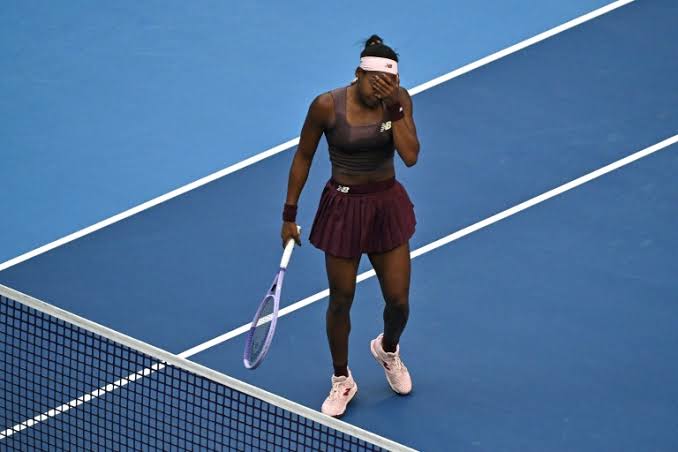
Coco Gauff has made a decision that should spark a much bigger conversation in tennis. The American star will not defend her Wuhan Open title, choosing to step away from competition after a difficult stretch in Beijing that included a shocking loss, intense online racist abuse, and the physical demands of a long season.
On the surface, this looks like another tournament withdrawal. But the circumstances surrounding Gauff’s decision raise an uncomfortable question for the sport: What happens when the pressure of being a professional tennis star follows a player long after the match is over?
Gauff, one of the biggest names in women’s tennis, found herself at the centre of a social media storm after a disputed point during her China Open victory over China’s Sun Xinran. The disagreement over whether the point should have been replayed quickly grew beyond tennis, with Gauff reporting an alarming volume of racist comments and direct messages.
Days later, she lost to Belgium’s Elise Mertens in the fourth round of the China Open and announced that she would skip Wuhan, where she was the defending champion.
Gauff said her body needed time to rest and recover after a long year. She did not present the withdrawal as being caused solely by the abuse, but her experience has placed the issue of online harassment back in the spotlight.
For SportsLoud, the bigger story is not simply that Gauff is missing another tournament. It is whether tennis can do more to protect the people who make the sport worth watching.
One Disputed Point Turned Into Something Much Bigger
The controversy began during Gauff’s match against 16-year-old Chinese player Sun Xinran at the China Open.
During a crucial point, Gauff raised her hand to stop play because she said flickering advertising lights were distracting her. Sun appeared to have hit a potential winner, but after a video review, the umpire ordered the point to be replayed.
Gauff went on to win the match 7–5, 6–1.
A disputed call is hardly unusual in professional sport. Players challenge decisions, spectators disagree with officials, and controversial moments are replayed and debated for days. In this case, however, the reaction moved far beyond criticism of the decision.
Gauff said she received an enormous number of racist comments and direct messages. She pushed back against the attacks, making clear that people could disagree with her without resorting to racism.
She also explained that she had spoken with Sun after the match and that the young Chinese player understood the situation.
That detail matters. The two athletes had competed against each other, but the online reaction transformed a disputed moment into a personal attack on Gauff.
Fans are entitled to question a call. They can argue that an official made the wrong decision or that a player benefited from a rule. What they cannot reasonably demand is the right to target an athlete’s race because they dislike what happened on court.
When criticism becomes racist abuse, the conversation is no longer about tennis.
The Scoreboard Does Not Show the Whole Cost
Gauff’s next match brought another difficult chapter.
The American lost 6–3, 6–3 to Mertens in Beijing, ending her run at the tournament. She made 34 unforced errors and eight double faults, struggling to find the consistency needed to overcome her Belgian opponent.
Afterward, Gauff acknowledged that the previous few days had been draining.
It would be unfair to claim that online abuse alone caused her defeat. Tennis matches are complicated, and Gauff herself pointed to aspects of her performance that needed improvement. Her loss should not automatically be reduced to what happened on social media.
But it would also be a mistake to pretend that professional athletes can always separate the competition from everything happening around them.
Players face intense travel schedules, physical fatigue, tactical pressure, public scrutiny, and expectations to deliver results week after week. Social media adds another layer: the criticism can continue in a player’s phone, hotel room, or private time long after the crowd has left the stadium.
For a prominent athlete, turning off a phone may provide some relief, but it does not erase the fact that abuse has occurred.
Gauff’s experience highlights a problem that statistics cannot fully capture. Fans see the final score, the ranking points, and the prize money. They do not necessarily see the emotional burden that comes with being publicly attacked.
That does not mean athletes should be shielded from every negative opinion. It means there should be a clearer distinction between fair criticism and targeted abuse.
Tennis Has Taken Steps, but Is That Enough?
The WTA has publicly condemned the racist attacks and expressed support for Gauff. The organisation has also worked with technology partners on systems designed to monitor abusive messages directed at players and officials.
Those efforts matter. Online abuse is not unique to tennis, and the volume of comments generated around major sporting events can make manual moderation difficult. Monitoring tools can help identify harmful messages and give players a way to report what they receive.
But detection is only part of the problem.
What happens after abuse is identified? Are accounts consistently penalised? Can threats be escalated quickly? Do players have accessible ways to report coordinated harassment without spending hours documenting it themselves?
These are the questions tennis administrators, tournament organisers, and social media platforms need to address.
There is also a question of responsibility. The WTA can set policies and support players, but it cannot independently control every social media platform. Technology companies have their own moderation systems, and users can create new accounts after being suspended.
That makes cooperation essential. Tennis organisations need clear reporting channels, transparent follow-up, and practical support for players dealing with abuse. Social media platforms need to enforce their own rules against racist harassment rather than leaving athletes to absorb the consequences.
No single measure will eliminate online abuse. But a system that identifies harmful behaviour without meaningful follow-up risks leaving players with the same problem the next time a controversial match takes place.
Gauff Should Not Have to Choose Between Competing and Protecting Her Peace
One of the most striking aspects of this story is that Gauff’s withdrawal comes at a cost.
She won the Wuhan Open in 2025 without dropping a set, making her the defending champion. By withdrawing from the 2026 tournament, she gives up the opportunity to defend that title and earn more ranking points.
Her stated reason was the need for rest and recovery after a long season. That is a legitimate consideration in a sport where players spend much of the year travelling and competing.
The timing nevertheless puts a spotlight on the demands placed on top athletes. Tennis rewards consistency, but the calendar can leave little room for recovery, especially for players who go deep in multiple tournaments.
Gauff is not the first player to miss an event after a demanding stretch, and her decision should not be treated as proof that online abuse alone forced her away from competition.
The more useful question is why the sport so often discusses player welfare only after a prominent athlete reaches a difficult point.
Rest should not be seen as weakness. Neither should seeking support after being targeted online.
Professional tennis needs its stars to compete at a high level, but it also needs to recognise that they are people rather than endless sources of entertainment. A player’s willingness to step away from a tournament should not become another reason for strangers to attack them.
Gauff has already achieved major success, including winning the US Open in 2023 and the Wuhan title in 2025. Missing one tournament does not erase those accomplishments or define the direction of her career.
It simply means she will not compete in Wuhan this time.
There Is a Difference Between Passionate Fans and Abusive Fans
Tennis thrives on strong opinions. Rivalries, disputed calls, controversial decisions, and unexpected results are part of what makes the sport compelling.
Fans should be able to criticise a player who performs poorly. They should be able to argue that an umpire made the wrong decision or that a tournament needs better procedures. Honest debate helps keep sport interesting.
But racism is not an alternative form of analysis.
When criticism targets a player’s race instead of their performance, it does nothing to improve the sport. It shifts attention away from the actual issue and turns a competition into an excuse for personal abuse.
Gauff’s situation also demonstrates how quickly online discussion can escalate. A single incident becomes a viral clip, the clip attracts competing interpretations, and some users turn disagreement into harassment. The athlete at the centre of the story can then face thousands of messages from people who know almost nothing about them beyond the moment that triggered the controversy.
The solution cannot be to tell players to ignore everything. Athletes may choose to step away from social media, but that should be a personal coping strategy rather than the sport’s entire response.
Tennis needs passionate fans. It does not need fans who believe that supporting one player gives them permission to abuse another.
SportsLoud Verdict: The Real Test Is What Tennis Does Next
Coco Gauff’s withdrawal from Wuhan is not proof that racism alone caused her to step away. Her stated explanation was that she needed rest and recovery after a long season. Still, her experience in Beijing has exposed an issue that tennis cannot afford to ignore.
The WTA’s public support is welcome, and technology-assisted monitoring is a useful step. But the bigger test is whether players can see meaningful action when abuse occurs, rather than simply receiving statements of sympathy after the damage has been done.
Tennis authorities should continue improving reporting systems, working with social media platforms, and communicating what action can be taken against abusive accounts. Tournament organisers should also ensure players have clear support channels when incidents escalate.
At the same time, fans have a responsibility to recognise that disagreement is part of sport, while racism has no place in it.
Gauff will have time to recover before returning to competition. Her decision should be respected without speculation about her private state of mind or assumptions about what caused every aspect of her recent performance.
The question for tennis is bigger than one player or one tournament.
If a sport wants its stars to perform under the brightest spotlight, it also has to take responsibility for what happens when that spotlight turns into a target.
So, is tennis doing enough to protect its stars? The measures already in place show that the issue is being addressed, but Gauff’s experience makes clear that there is still work to do. The next step is turning public support into consistent, practical protection.