


















There are footballers who seem destined for greatness from the moment they step onto a pitch. Their talent is obvious, their names become famous before they reach adulthood, and the world begins preparing for their success long before they have earned it.
Harry Kane’s story was different.
His journey was not always glamorous. It was not a straight line from a promising young player to football’s biggest stage. There were loan spells, doubts about his ability, years of carrying enormous expectations and painful moments when the biggest prizes seemed just out of reach.
On Monday night in London, all those chapters came together.
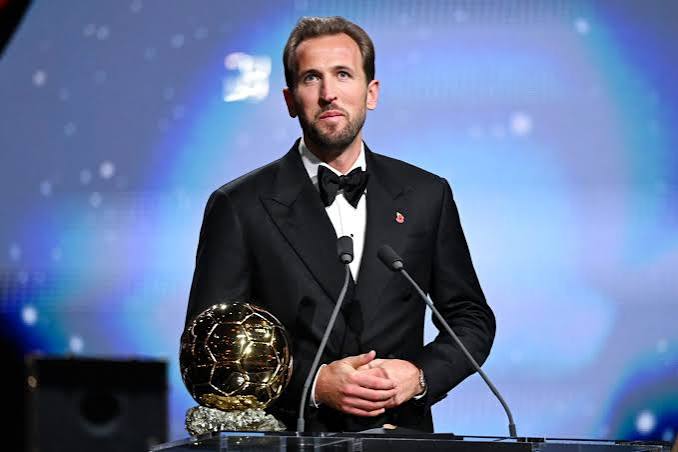
At 33, the England captain stood before the football world and received the 2026 Ballon d’Or, becoming the first Englishman to win the men’s award since Michael Owen in 2001. He had scored 73 goals for club and country during the 2025–26 season, helped Bayern Munich win major domestic honours and captained England to a third-place finish at the World Cup. <a href=”https://www.uefa.com/uefachampionsleague/news/02aa-21ec47378e70-b29defb43769-1000–harry-kane-wins-2026-men-s-ballon-d-or/“>UEFA’s report on Kane’s historic victory</a> captured the significance of the achievement.
But the most touching part of this story is not the number of goals he scored.
It is everything he had to become before he could finally hold that trophy.
Before the Golden Ball, There Were Years of Trying to Prove He Belonged
Today, Harry Kane is one of the most recognisable strikers in world football. His name commands respect, his goals speak for themselves, and defenders know exactly how dangerous he can be.
That was not always the case.
Kane joined Tottenham Hotspur’s academy as a child, but he did not immediately become the superstar fans would eventually know. Loan spells at Leyton Orient, Millwall, Norwich City and Leicester City formed part of his early career as he searched for opportunities to prove himself. <a href=”https://www.tottenhamhotspur.com/news/1181210/harry-kane-wins-2026-ballon-dor-tottenham-hotspur“>Tottenham’s account of his journey</a> reflects just how long the road was.
Imagine working toward a dream while knowing that every opportunity could be your chance to convince someone you deserve another one.
Imagine being a young striker, watching other players receive attention while you are still trying to establish yourself.
Football can be cruel to players who do not become stars quickly enough. People judge potential before patience has had time to work. A quiet spell can become a label, and a difficult season can convince outsiders that a player has reached his limit.
Kane kept going.
He continued working until he earned his opportunity at Tottenham, eventually becoming the club’s record goalscorer with 280 goals in 435 appearances.
The player who once had to fight for opportunities became the player his team depended on.
That is why his Ballon d’Or victory feels bigger than one brilliant season. It is the reward for a career built through persistence, including the years when the destination must have seemed very far away.
The Goals Were Never the Whole Story
Kane’s career has often been discussed through statistics. How many goals has he scored? How many records has he broken? How many matches has he decided?
The numbers matter. His 73 goals across the 2025–26 campaign are extraordinary, and his performances helped Bayern retain the Bundesliga title and win the German Cup. <a href=”https://www.reuters.com/sports/soccer/england-bayern-forward-kane-crowned-2026-ballon-dor-winner-2026-10-26/“>Reuters reported on the scale of his achievement</a> after Monday’s ceremony.
Yet statistics cannot fully explain why this moment feels so meaningful.
Kane has spent years being measured against what he had not achieved. At Tottenham, he became one of the Premier League’s most prolific strikers, but the major team trophies remained elusive. With England, he carried the responsibility that comes with captaining a nation that has waited decades for another major men’s international triumph.
He became a player whose brilliance was sometimes discussed alongside the disappointments of the teams around him.
That can be a difficult burden for any footballer. When a player becomes the face of a team’s hopes, every missed opportunity attracts attention. Every defeat invites questions. And even when the individual performs, the absence of a trophy can become the loudest part of the conversation.
Kane did not escape those questions by giving up on the challenge. He kept scoring, kept leading and kept working.
His move to Bayern Munich in 2023 gave him a new environment in which to pursue major honours. It also brought a new kind of pressure: proving that his goals could help a different team compete for the biggest prizes.
Now, with domestic silverware and the Ballon d’Or, he has another answer to the doubts that followed him.
Sometimes, a New Chapter Does Not Mean Forgetting the Old One
When Kane left Tottenham for Bayern Munich, it marked the end of an era.
For many Tottenham supporters, he was more than a striker. He was an academy graduate who became the club’s leading scorer and one of the defining players of his generation. His departure was an emotional moment because the club was losing someone who had grown into its history.
Winning the Ballon d’Or with Bayern does not erase those years.
In fact, they are part of what makes the victory so powerful.
Kane acknowledged Tottenham during his acceptance speech, thanking the club for the guidance, coaches and experiences that helped shape his career. He recognised that the journey included ups and downs, and that the people who supported him along the way had played a part in bringing him to that moment.
That gratitude matters.
Success can make it tempting to look backward only at the disappointments or the places where things did not work out as hoped. But Kane’s story shows that a chapter can matter even if it does not deliver the ending you wanted.
Tottenham helped shape the player who eventually won football’s greatest individual prize. Bayern provided the stage on which he combined his goalscoring brilliance with major team success.
Different chapters. Different challenges. One journey.
And for the young players who are still waiting for their opportunity, that may be one of the most valuable lessons in Kane’s story: not every step has to be the final destination to be worth taking.
At 33, Kane Has Given Patience a Face
Football often celebrates youth.
The next wonderkid, the teenager who breaks a record, the young superstar expected to dominate the next decade. There is excitement in discovering a player before the rest of the world catches up.
Kane’s victory tells a different kind of story.
He won the Ballon d’Or at 33, after years of development, setbacks and responsibilities. He finished ahead of Kylian Mbappé and Lamine Yamal, two players whose extraordinary talent has made them central figures in football’s present and future.
Kane’s triumph is a reminder that greatness does not have one timetable.
Some players explode onto the scene at an early age. Others take longer to find their place, build confidence and turn promise into consistency. A slower beginning does not mean a smaller ending.
For a young footballer sitting on a bench, struggling to make a team or wondering whether the dream is still realistic, Kane’s career offers something more meaningful than a motivational slogan.
It offers an example.
The difficult years did not define the limits of his future. They became part of the work that carried him toward it.
His message at the ceremony reflected that belief, emphasising hard work, resilience, determination and self-belief. He also thanked the coaches, teammates, supporters, friends and family who helped him along the way. <a href=”https://www.englandfootball.com/articles/2026/Oct/26/harry-kane-ballon-d-or-2026-reaction-20262610“>England Football published his reaction to the award</a> following the ceremony.
No single award can repay every difficult day in a career. But this one gave Kane a moment in which the world could recognise how much the journey had demanded of him.
This Was Bigger Than England Ending a 25-Year Wait
Kane is the first Englishman since Michael Owen in 2001 to win the men’s Ballon d’Or. That alone makes the moment historic.
But this victory belongs to more than English football.
It belongs to every player who has ever been overlooked. Every young athlete who has had to take the longer road. Every person who has watched someone else receive the opportunity they wanted and wondered when their own moment would arrive.
It belongs to those who understand that perseverance is not always dramatic. Sometimes it is simply turning up again, training again, learning from disappointment and refusing to let one setback write the ending.
Kane did not win this award because his career was perfect. He won it after a career that demanded patience, adaptation and an extraordinary level of consistency.
And perhaps that is why the sight of him holding the Ballon d’Or resonates beyond the football pitch.
The trophy celebrates his best season. The story celebrates everything that came before it.
Harry Kane Finally Got His Moment
There will be debates about whether Kane deserved the award ahead of Mbappé or Yamal. There will be arguments about goals, trophies, creativity and individual influence. That is part of what makes the Ballon d’Or so compelling.
But there is something worth pausing to appreciate before the debate begins.
A young boy entered Tottenham’s academy with a dream. He went out on loan, worked his way into the first team, became a record-breaking striker, captained his country and moved to Germany to pursue the success he still wanted.
Then, on a night in London, his name was called.
Harry Kane finally became the best men’s player in the world according to the Ballon d’Or voters.
He stood there not as the young prospect people once doubted, nor as the striker still searching for recognition, but as a player whose career had reached a place that once seemed impossibly distant.
The golden ball was the reward. The journey was the story.
And for every person still working toward a dream that has taken longer than expected, Kane’s moment carries a message worth remembering:
You are not finished just because your story has taken the longer road.
Sometimes, the moment you have been waiting for arrives years after you first imagined it.
And when it finally does, every difficult step can become part of what makes it beautiful.