





















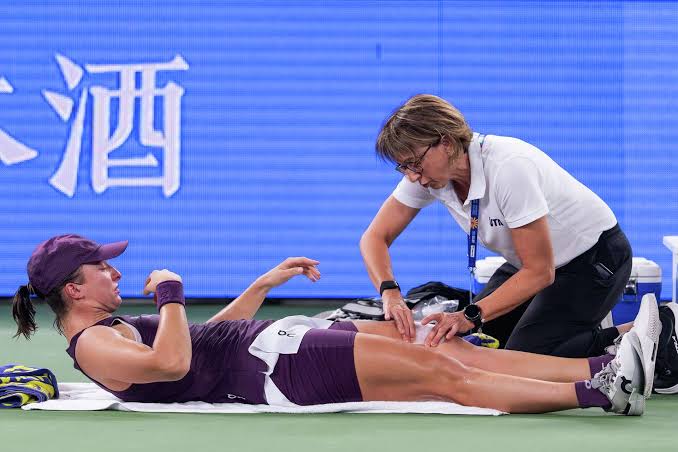
Iga Swiatek was supposed to be fighting for a place among the best eight players in women’s tennis. Instead, the six-time Grand Slam champion is watching the WTA Finals qualification race move forward without her.
Swiatek has withdrawn from the Ningbo Open in China because of a persistent left-thigh injury, ending her final opportunity to qualify directly for the 2026 WTA Finals. The timing could hardly be worse. The Polish star needed a strong result in Ningbo to keep her season-ending championship hopes alive, but her body has forced her to stop.
This is more than a missed tournament. It is another painful chapter in a season that has not delivered the results Swiatek or her supporters expected.
She has won only one title this year and has not reached the quarter-finals at any Grand Slam tournament. Now, with the WTA Finals approaching, the question is no longer simply whether Swiatek can win another trophy. It is whether she can get healthy enough to finish the season on a positive note.
Ningbo Was Swiatek’s Last Direct Route to the Finals
The WTA Finals bring together the eight best-performing singles players of the season. Qualification is based on the points players collect throughout the year, making every late-season tournament important for those fighting to secure the final places.
Swiatek entered Ningbo needing to reach at least the quarter-finals to overtake Karolina Muchova in the race for the final qualifying position.
That opportunity is now gone.
Her withdrawal means Muchova has retained the advantage in the qualification battle, while Swiatek’s hopes of earning a place through the rankings have effectively ended.
There is still a small possibility that Swiatek could appear as an alternate if a qualified player withdraws. But that is a very different situation from earning her place through her own results.
For a player who has spent years among the sport’s leading names, depending on another player’s injury or withdrawal would be an uncomfortable way to reach the season-ending championship.
The Wuhan Injury Was the Warning Sign
Swiatek’s withdrawal did not come out of nowhere.
At the Wuhan Open, she struggled with the same left-leg problem during her semi-final against fellow Pole Maja Chwalinska. Swiatek had been leading 5–3 in the opening set before requiring medical attention.
She continued playing, but the injury clearly affected her movement. Chwalinska eventually won 7–5, 6–1, ending Swiatek’s run in the tournament.
That defeat was disappointing, but the physical condition Swiatek showed during the match was even more concerning.
Tennis at the highest level requires explosive movement in every direction. Players must sprint, slide, change direction and recover quickly between points. A thigh injury can make all of those movements difficult, particularly when the player is trying to defend against powerful opponents.
Swiatek’s decision to withdraw from Ningbo suggests that the problem had not improved enough for her to compete safely.
The difficult question is whether continuing to chase ranking points would have been worth the risk of making the injury worse.
This Is Not the Season Swiatek Expected
Swiatek’s recent results make the situation more frustrating.
She is a six-time Grand Slam champion and has previously won the WTA Finals, in 2023. Those achievements created expectations that she would remain a major contender throughout 2026.
Instead, her season has been marked by missed opportunities.
She has managed just one tournament victory and failed to reach the quarter-finals at any of the four Grand Slam events. That does not erase her previous accomplishments, but it does show how far this year has fallen short of her usual standards.
The injury now adds another layer to the disappointment.
When a player is struggling for results, late-season tournaments can provide a chance to rebuild confidence and finish with momentum. Swiatek has lost that opportunity in Ningbo, and she cannot simply replace those matches with another event that offers the same qualification points.
There is no guarantee that a healthy Swiatek would have qualified. She still needed to produce a strong result against a competitive field. But at least she would have had control over her own chances.
Now she does not.
Muchova and Svitolina Have Taken Advantage
While Swiatek’s hopes have faded, other players have strengthened their positions.
Karolina Muchova has benefited from Swiatek’s withdrawal in the race for the final qualification spot. Muchova’s position matters because the season-ending championship rewards consistency across the calendar, not simply a player’s reputation or previous titles.
Elina Svitolina has also secured her place at the WTA Finals, becoming the seventh player to qualify.
That leaves the remaining contenders fighting for the final available position, with Marta Kostyuk among the players still capable of making a late push.
The contrast is striking.
Swiatek has been one of the defining players of recent seasons, yet the WTA Finals race is moving toward its conclusion without her guaranteed participation. Meanwhile, players who have accumulated enough points over the course of the year are being rewarded for their performances.
That is the reality of the rankings system. Past championships do not provide automatic entry.
Should Swiatek Have Stopped Playing Earlier?
This is where the debate gets interesting.
Some fans may argue that Swiatek should have protected herself earlier rather than continuing through the Wuhan semi-final while visibly struggling with her thigh.
Others will point out that elite athletes often compete through discomfort, especially when a major tournament and valuable ranking points are at stake.
Neither argument changes the immediate situation.
Swiatek has now withdrawn from Ningbo, and the priority should be getting her fit rather than rushing her back for the sake of one more appearance.
The danger is that a player trying to rescue a disappointing season can make decisions based on frustration. A return that comes too early could leave Swiatek dealing with the same problem when the new season begins.
For someone whose game relies so heavily on movement and aggressive positioning, full recovery is essential.
SportsLoud’s Take: Missing the Finals Could Be a Blessing in Disguise
The WTA Finals are one of the biggest stages in tennis, and Swiatek would undoubtedly prefer to qualify through her own results.
But if the thigh injury is still troubling her, missing the tournament might ultimately be less damaging than forcing her way into another week of competition.
Swiatek does not need to prove that she belongs among the world’s best players. Her Grand Slam record has already answered that question.
What she needs now is a healthy offseason, a clear recovery plan and the opportunity to rebuild the confidence that has been missing from parts of her 2026 campaign.
The concern is not that one withdrawal has suddenly made Swiatek a lesser player. It is that the injury has arrived during a season when she desperately needed consistency.
Her WTA Finals hopes are in serious trouble, and the direct qualification door is now closed.
The bigger challenge is making sure this setback does not follow her into 2027.
The question for Swiatek is no longer whether she can qualify for the WTA Finals this year. It is whether she can recover in time to remind the tennis world why she was once the player everyone else was chasing.