




















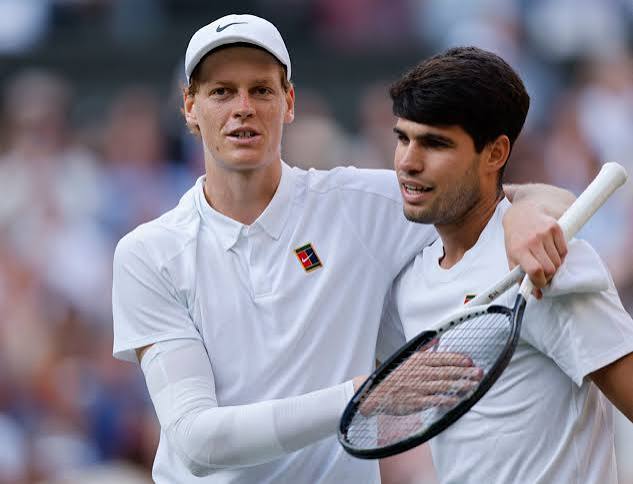
For the last couple of years, men’s tennis has felt like a two-player conversation.
Carlos Alcaraz or Jannik Sinner?
That question has followed both players everywhere. Every Grand Slam creates another opportunity to compare them. Every time they meet, the match feels bigger than an ordinary final. And every time one of them wins, the tennis world starts asking whether that player has finally established himself as the best of the new generation.
But there is now a new twist.
Alexander Zverev has just won the 2026 US Open, claiming his second Grand Slam title of the season, while Sinner remains at No. 1 in the ATP rankings and Alcaraz has fallen to No. 3.
So the question isn’t simply about who has the better ranking.
It’s about something much more interesting:
If you could choose one player to build your team around right now, would you take Alcaraz or Sinner?
There are arguments for both.
Sinner Has the Numbers Right Now
If we’re talking about the current ranking, Sinner has the clearest advantage.
Following the US Open, the Italian remains world No. 1 with 11,500 ranking points. Zverev moved into second with 9,690, while Alcaraz sits third with 5,560.
That doesn’t automatically settle the debate, but it tells us something important.
Sinner has been incredibly consistent at the top.
His game is built around pressure.
He hits the ball extremely hard from both wings, takes the ball early and constantly pushes opponents backward. Once Sinner gets into a rhythm, opponents can find themselves defending point after point.
His movement has also become one of the most underrated parts of his game.
At first glance, Sinner’s tennis can look almost simple.
Big forehand.
Big backhand.
Big serve.
Aggressive returns.
But that’s exactly what makes it so difficult to beat.
He doesn’t need to produce something spectacular every point.
He can simply keep applying pressure until the opponent breaks.
But Alcaraz Has Something Sinner Doesn’t
Then there is Alcaraz.
If Sinner is the machine, Alcaraz is the improviser.
The Spaniard can change direction, use the drop shot, attack the net, defend from impossible positions and suddenly turn a defensive point into an offensive one.
There are very few players who can create as many different problems during the same match.
And his Grand Slam resume is already remarkable.
Alcaraz won the Australian Open in 2026, becoming the youngest man in history to complete the career Grand Slam. The US Open’s official site notes that he had won all four majors by the age of 22 and entered the 2026 US Open as a seven-time Grand Slam champion.
That is a ridiculous amount of achievement for someone who is still so young.
And it makes the Alcaraz argument very simple:
When the biggest trophies are on the line, he has already shown that he knows how to win them.
Their Head-to-Head Makes This Even More Interesting
Here’s where this rivalry gets really good.
Alcaraz and Sinner have played 10 times, and their head-to-head is currently tied 5–5.
That’s about as close as a rivalry can get.
Their recent meetings have also produced some incredible matches.
Alcaraz defeated Sinner in the 2025 French Open final after coming back from two sets down. Sinner then defeated Alcaraz in the 2025 Wimbledon final.
Later that year, Alcaraz won the 2025 US Open final against Sinner.
Then Sinner beat Alcaraz in the 2025 ATP Finals and again in the 2026 Monte Carlo final. Their recent meetings show exactly why neither player has been able to completely separate himself from the other.
And that is fantastic for tennis.
There isn’t a rivalry where one player consistently destroys the other.
There isn’t a predictable formula.
Every match feels like it can go either way.
Category 1: Serve — Sinner
This is where I give Sinner the advantage.
His serve has become a major weapon, particularly because he can combine power with placement.
Alcaraz has improved significantly in this area, but Sinner’s serve fits perfectly with his overall game.
He wants short points.
He wants to get the first big shot after the serve.
And he wants to control the rally immediately.
Sinner gets the edge here.
Category 2: Variety — Alcaraz
This one goes to Alcaraz.
It’s difficult to think of another young player who can change styles so quickly.
He can play aggressively from the baseline.
He can defend.
He can use the drop shot.
He can come forward.
He can hit spectacular passing shots.
And he can make an opponent uncomfortable simply by changing the rhythm.
Sinner has improved his variety, but Alcaraz still has more ways to hurt you.
Category 3: Power — Sinner
Sinner’s ball is frightening.
His groundstrokes can be so clean and heavy that opponents are often forced into defensive positions before they even realize what happened.
Alcaraz isn’t lacking power, but Sinner’s ability to repeatedly hit deep, penetrating shots makes him particularly difficult on hard courts.
Sinner gets this one.
Category 4: Athleticism — Alcaraz
This is another area where Alcaraz has a special advantage.
His speed around the court is extraordinary.
But it’s not just straight-line speed.
It’s the ability to stop, change direction and somehow get a racket on balls that look completely out of reach.
That’s where Alcaraz can frustrate Sinner.
You think you’ve hit the perfect shot.
Then Alcaraz is somehow there.
Category 5: Big-Match Experience — Alcaraz
This category is closer than some fans might think.
Sinner has already played and won major finals.
But Alcaraz has built an extraordinary Grand Slam record at an incredibly young age.
He has also beaten Sinner on the biggest stages.
The 2025 US Open final is a perfect example.
Alcaraz defeated Sinner in four sets to win his second US Open title and reclaim the No. 1 ranking at the time.
That doesn’t mean Alcaraz will always win the biggest matches.
But it gives him a strong case when we’re talking about proven Grand Slam performance.
Category 6: Consistency — Sinner
This is where the current ranking matters.
Sinner has spent significant time at No. 1 and remains there after the 2026 US Open.
His ability to consistently perform at the highest level is one of the biggest reasons he has become the player to beat in the rankings.
Alcaraz has also been remarkably successful, but injuries have complicated his 2026 season.
He missed several months with a right wrist injury before returning for the US Open.
That matters.
Being the best player in the world isn’t only about your highest level.
It’s also about how often you can reach it.
The Injury Factor Changes the Conversation
This is probably the biggest thing people should remember when comparing them right now.
Sinner missed the 2026 US Open with a knee injury, while Alcaraz returned to competition after his wrist problem.
That created a strange final Grand Slam of the season.
For the first time in years, the men’s tournament didn’t have Sinner and Alcaraz battling for the title.
Zverev took advantage and won the championship.
The US Open itself described Sinner’s absence as a major storyline because the world No. 1 was missing from the tournament.
And that leads to an important point:
The Alcaraz-Sinner rivalry isn’t going anywhere just because someone else won the US Open.
If anything, Zverev’s victory makes the next chapter more interesting.
So Who Would I Take?
If you’re asking:
Who is the better player right now based on consistency and ranking?
The numbers point toward Sinner.
He’s No. 1 and has maintained the strongest ranking position.
If you’re asking:
Who has the more complete and unpredictable game?
That’s where Alcaraz has a serious argument.
And if you’re asking:
Who has the better Grand Slam resume at this stage of their careers?
Alcaraz has built an extraordinary case, including completing the career Grand Slam at just 22.
That’s why I don’t think the answer is as simple as saying one player is clearly better.
They are different types of superstars.
Sinner overwhelms you.
Alcaraz disrupts you.
Sinner wants to turn the match into a high-speed baseline battle.
Alcaraz wants to make you uncomfortable and force you to solve different problems.
And when they meet, those two styles collide.
The Most Important Thing Is What Happens Next
The biggest mistake would be treating the 2026 US Open as the end of the Alcaraz-Sinner era.
It’s not.
Zverev has now shown that another player can break through.
But the sport still has two young stars with a rivalry that is tied at 5–5.
That is incredibly rare.
And because they are still so young, there is no reason to believe we have seen the best version of either player yet.
Sinner can continue improving his serve, net game and physical conditioning.
Alcaraz can become even more consistent, sharpen his serve and learn how to manage a full season without the interruptions that injuries can cause.
That is what makes this rivalry so exciting.
We aren’t comparing two players at the end of their careers.
We’re comparing two players who could define men’s tennis for years.
My Verdict
If I had to choose the player I trust most right now, I’d lean toward Sinner because the current ranking, consistency and overall level give him the stronger case.
But if I had to choose the player I’d want in a match where everything is on the line, Alcaraz makes the decision extremely difficult.
And that’s the beauty of this rivalry.
There doesn’t need to be a permanent answer.
Maybe Sinner is No. 1 today.
Maybe Alcaraz wins the next major.
Maybe Zverev crashes the party again.
That’s exactly what tennis needs.
For years, fans watched Federer, Nadal and Djokovic dominate the sport.
Now a new generation is creating its own rivalry.
And if Alcaraz and Sinner continue pushing each other the way they have so far, we could be watching the beginning of another era that tennis fans will talk about for decades.
Alcaraz vs Sinner isn’t finished.
It might only be getting started.