




















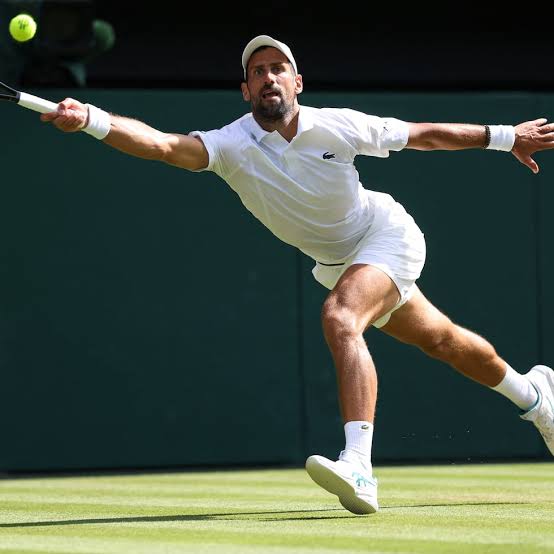
At some point, tennis was supposed to move on from Novak Djokovic.
The younger generation was coming.
Carlos Alcaraz was coming.
Jannik Sinner was coming.
Alexander Zverev was coming.
Daniil Medvedev was supposed to be part of the generation that finally pushed the old guard out.
But Djokovic apparently didn’t get the memo.
He’s 39 years old.
And he’s still beating them.
The latest example came in Beijing, where Djokovic defeated top seed Alexander Zverev 4–6, 6–4, 6–4 to reach the China Open semifinals. Then came an even stranger semifinal against Medvedev, which Djokovic was leading 7–5, 5–3 when Medvedev was defaulted after hitting a ball into the crowd that struck a spectator.
Now Djokovic is in the final.
At 39.
Against Alex de Minaur.
And suddenly, one question is getting harder and harder to ignore:
How is Novak Djokovic still doing this?
The Young Guys Were Supposed to Take Over
For years, tennis fans heard the same prediction.
The Big Three era was ending.
Roger Federer was gone.
Rafael Nadal was gone.
Djokovic was getting older.
Eventually, the younger players would take control.
And to be fair, that transition has happened to some extent.
Sinner is currently ranked No. 1.
Alcaraz is No. 3.
Zverev is No. 2.
The future of men’s tennis is clearly in their hands.
But Djokovic keeps showing up at the most inconvenient possible time.
Just when someone thinks they’ve finally moved past him, he produces another performance that makes everybody reconsider.
That’s exactly what happened with Zverev.
Zverev Had Every Reason to Believe He Could Beat Him
Zverev is 29.
Djokovic is 39.
That’s a 10-year age difference.
Zverev is in his physical prime.
Djokovic is approaching 40.
And Zverev came into the match as the top seed.
He also had plenty of momentum.
Yet Djokovic absorbed the German’s power, survived a difficult opening set and slowly turned the match around.
Zverev hit 19 aces.
It didn’t matter.
Djokovic won the final two sets 6–4, 6–4 and completed the comeback after breaking Zverev late in both sets.
That’s the Djokovic formula we’ve seen for years.
You think you’ve got him.
Then suddenly you’re sitting down wondering how the match disappeared.
Age Is Supposed to Be the Problem
This is what makes Djokovic’s current run so fascinating.
Tennis is brutal on the body.
It’s not just about hitting a tennis ball.
Players have to sprint.
Stop.
Change direction.
Slide.
Recover.
Serve.
Repeat.
For hours.
And they have to do it tournament after tournament.
At 25, that’s difficult.
At 30, it’s difficult.
At 39?
It should be almost impossible.
Yet Djokovic continues to find ways around the physical limitations that eventually catch every athlete.
He doesn’t necessarily need to outrun younger players.
He needs to outthink them.
And that’s where his experience becomes dangerous.
Djokovic Doesn’t Need to Be the Fastest Player Anymore
This might be the biggest misconception about Djokovic at this stage of his career.
He doesn’t have to play like the Djokovic of 2011.
He doesn’t need to dominate every point.
He doesn’t need to win every long rally.
He needs to choose the right moments.
Against Zverev, Djokovic waited.
He absorbed pressure.
He changed the rhythm.
He attacked when the opportunity appeared.
And when the match reached 5–4 in the second and third sets, Djokovic produced the breaks that mattered most.
That’s not simply physical ability.
That’s decades of experience compressed into a few crucial points.
Then Medvedev Became the Next Victim — Sort Of
The semifinal against Daniil Medvedev ended in bizarre circumstances.
Djokovic was leading 7–5, 5–3 when Medvedev hit a ball into the crowd and struck a spectator.
The officials defaulted Medvedev, ending the match.
It wasn’t the way Djokovic would have wanted to win.
And he made that clear.
Djokovic said he felt sorry for Medvedev because he knows exactly what it feels like to be disqualified from a major match. Djokovic himself was defaulted from the 2020 US Open after hitting a ball that struck a line judge.
But regardless of how the match ended, Djokovic was already in control.
He was one game away from reaching the final.
And that adds another bizarre chapter to his 2026 Beijing run.
Now He’s 33–0 in Beijing
This might be the craziest statistic of the entire story.
33 wins.
Zero losses.
That’s Djokovic’s record at the China Open after reaching the 2026 final.
He’s won all of his matches in Beijing across his appearances at the tournament, and he’s now one victory away from a seventh China Open championship.
Think about that.
A player who is 39 years old is still producing numbers that look like something from the beginning of his career.
And he’s doing it at a tournament he hasn’t even played since 2015.
The Next Generation Keeps Getting the Same Lesson
This is where the story gets spicy.
The younger generation isn’t losing to a 25-year-old Djokovic.
They’re losing to a 39-year-old Djokovic.
That has to be frustrating.
Because every time one of these players steps onto the court against him, they know they should have the physical advantage.
But Djokovic keeps turning the match into a mental battle.
Can you stay calm?
Can you close the set?
Can you protect a lead?
Can you play your best tennis at 5–4?
Can you handle the pressure when Djokovic starts believing?
Those questions have destroyed plenty of talented players over the years.
And apparently, age hasn’t taken that weapon away from him.
Zverev’s Loss Could Be Bigger Than It Looks
For Zverev, the defeat wasn’t simply another tournament loss.
It also damaged his opportunity to make a serious move toward the No. 1 ranking.
Djokovic’s victory denied Zverev valuable momentum at exactly the wrong time.
That’s another reason Djokovic remains dangerous.
He isn’t just capable of winning matches.
He can interfere with the plans of players trying to take over the sport.
Zverev wants No. 1.
Sinner wants to stay there.
Alcaraz wants to get back there.
Djokovic?
He’s still standing in the way.
And Then There’s Alcaraz
While Djokovic is making noise in Beijing, Carlos Alcaraz is doing his own thing in Tokyo.
The 23-year-old reached the Japan Open final after coming from behind to beat Jaume Munar 5–7, 6–3, 6–1.
And that’s what makes the current tennis landscape so fascinating.
You have Alcaraz, the young superstar.
You have Sinner, the current No. 1.
You have Zverev, another established contender.
And then there’s Djokovic.
The 39-year-old who refuses to disappear.
It’s almost like tennis is caught between two generations.
Djokovic Isn’t Supposed to Be the Future
Let’s be honest.
Nobody is expecting Djokovic to be the future of men’s tennis.
That’s not the argument.
The future belongs to the younger players.
But Djokovic doesn’t need to be the future.
He just needs to remain good enough to ruin somebody else’s future plans.
And right now?
He’s doing exactly that.
There Is One Big Question We Can’t Ignore
How long can this continue?
That’s the part nobody knows.
Djokovic’s body has already shown signs of the wear and tear that comes with an extraordinary career.
He’s had physical issues.
He’s had difficult stretches.
And he hasn’t been able to dominate the tour the way he once did.
But that’s actually what makes this version of Djokovic more impressive.
He’s no longer winning everything.
He’s picking his moments.
And when he finds the right tournament, the old Djokovic suddenly appears.
Beijing appears to be one of those places.
The China Open May Be Djokovic’s Perfect Playground
There’s something about Beijing that brings out the best in him.
He’s now 33–0 there.
He’s won six China Open titles.
And he’s about to play for No. 7.
His next opponent is Alex de Minaur, who reached the final after Hubert Hurkacz retired while trailing 6–4, 3–2.
De Minaur is 27.
Another younger player.
Another opportunity for Djokovic to remind everyone that age isn’t automatically a disadvantage against him.
And Djokovic has already beaten De Minaur three times in four meetings.
So the Australian knows exactly what he’s walking into.
Could Djokovic Actually Win the Title?
Absolutely.
He’s already done the hard part.
He beat the top seed.
He survived another physically demanding match.
He’s reached the final without losing a match in Beijing.
And now he’s playing for his 102nd ATP Tour title.
The only thing standing between him and another trophy is De Minaur.
At 39.
That’s ridiculous.
SportsLoud’s Take: Don’t Say Djokovic Is Back — Say He Never Really Left
This is where I land.
I don’t think we should say:
“Novak Djokovic is back.”
Because that implies he disappeared.
He didn’t.
Maybe he isn’t dominating every tournament anymore.
Maybe he isn’t the overwhelming favorite at every Grand Slam.
Maybe Sinner and Alcaraz really are becoming the faces of the next era.
All of that can be true.
And Djokovic can still be dangerous.
That’s the key.
He doesn’t have to own tennis anymore to remain one of its biggest problems.
At 39, Djokovic has become something even more frustrating for the younger generation:
the veteran who knows exactly how to beat them.
He knows when they’re nervous.
He knows when they’re tired.
He knows when to slow the match down.
He knows when to attack.
And most importantly, he knows how to survive.
The Young Generation Better Enjoy the Challenge
Because Djokovic isn’t going anywhere quietly.
Sinner may be No. 1.
Alcaraz may be the biggest young superstar.
Zverev may have the power to dominate matches.
But until somebody consistently beats Djokovic when the stakes are high, the old king is still going to have something to say.
And that’s what makes men’s tennis so fascinating right now.
The future is arriving.
But the past isn’t ready to leave.
39 years old.
Still beating the younger generation.
Still reaching finals.
Still chasing trophies.
And now Novak Djokovic has another chance to remind the tennis world that maybe age really is just a number.
Because while everyone else is asking when Djokovic will finally step aside…
Djokovic keeps asking a very different question: