






















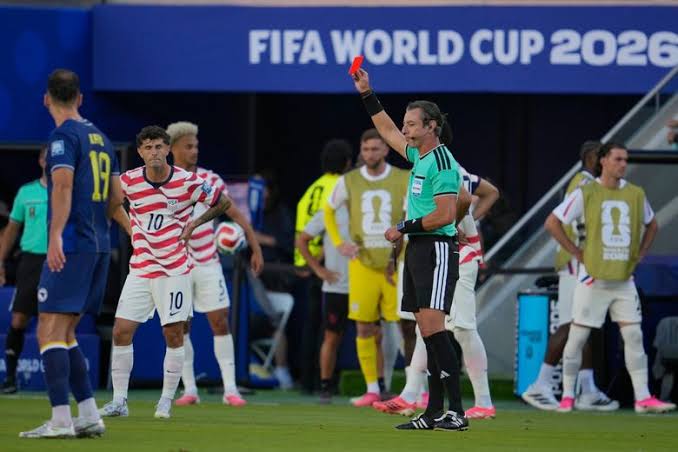
The FIFA World Cup 2026 has been rocked by one of its biggest controversies after FIFA made the extraordinary decision to suspend the one-match ban handed to United States striker Folarin Balogun, allowing him to play in the Round of 16 against Belgium despite being sent off in the previous match against Bosnia and Herzegovina.
Balogun was shown a straight red card during the USA’s 2-0 victory over Bosnia and Herzegovina after a VAR review concluded that his challenge on defender Tarik Muharemović amounted to serious foul play. The dismissal came in the second half and immediately sparked debate, with many pundits arguing that the contact appeared accidental and deserved only a yellow card.
Under World Cup regulations, a straight red card normally carries an automatic one-match suspension, meaning Balogun was expected to miss the crucial knockout clash against Belgium. FIFA officials initially confirmed there was no appeal process for the decision, making his absence seem inevitable.
Then came the stunning twist.
Just over a day before the Belgium match, FIFA announced that while Balogun’s red card would remain on his disciplinary record, the implementation of the suspension would be suspended for a one-year probationary period under Article 27 of the FIFA Disciplinary Code. The decision made the United States’ leading scorer immediately eligible to face Belgium.
The announcement triggered outrage across the football world.
Belgium’s football federation questioned the decision and said it was examining all available options, arguing that World Cup competition regulations clearly state that a player sent off must automatically miss the following match. The federation described FIFA’s interpretation of its disciplinary rules as inconsistent with the tournament regulations.
Fans also took to social media, with opinions sharply divided. Many believed the original red card was harsh and welcomed Balogun’s return. Others argued that if FIFA believed the challenge did not deserve a suspension, the proper course would have been to overturn the red card itself—not leave it in place while removing its immediate consequence. Online discussion frequently described the move as unprecedented and questioned whether it created uncertainty around the application of disciplinary rules.
The controversy has intensified because Balogun has been one of the standout performers for the United States during the tournament. His return gives Mauricio Pochettino a major boost ahead of the high-stakes encounter with Belgium, while critics argue that Belgium must now prepare for an opponent they had every reason to expect would be unavailable.
Whether FIFA’s decision will be remembered as a fair correction to a harsh punishment or as one of the tournament’s most contentious disciplinary rulings remains to be seen. What is certain is that the debate surrounding Folarin Balogun’s case has become one of the defining stories of the FIFA World Cup 2026, raising fresh questions about consistency, transparency, and the interpretation of football’s disciplinary rules.