





















Pieter Coetze has given the swimming world a new reason to pay attention.
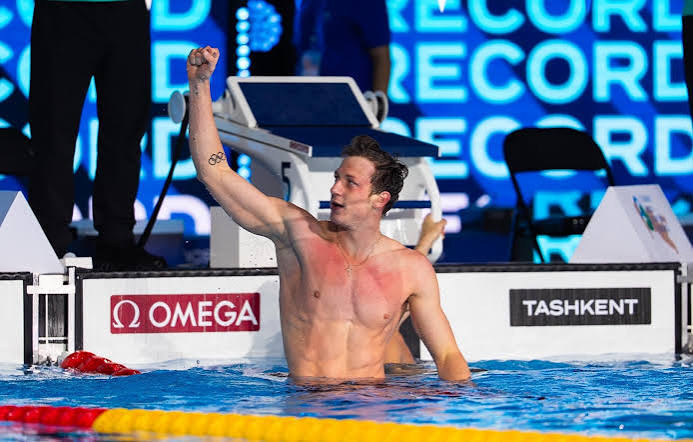
The 22-year-old South African delivered a stunning performance at the World Aquatics Swimming World Cup in Tashkent, Uzbekistan, on October 9, swimming the men’s 50-metre backstroke in 22.09 seconds to break the short-course world record.
The previous mark of 22.11 seconds belonged to Russian swimmer Kliment Kolesnikov and had stood since 2022. Coetze erased it by two hundredths of a second, turning an already impressive season into a historic one.
But this was not simply a young swimmer enjoying one extraordinary race. Coetze followed his record-breaking performance with another outstanding swim in the 100m backstroke, clocking 48.21 seconds — just five hundredths outside the world record.
That changes the conversation.
Is Coetze becoming the next dominant force in international backstroke swimming? And could his latest performances make him one of the most exciting swimmers to watch as the sport builds toward the Los Angeles 2028 Olympic Games?
For SportsLoud, the bigger story is not just the record. It is how quickly Coetze is turning potential into results.
Two Hundredths of a Second Changed Everything
Swimming records can be decided by the smallest margins, and Coetze’s breakthrough was a perfect example.
His time of 22.09 seconds improved Kolesnikov’s previous short-course world record by 0.02 seconds. That might sound insignificant to someone watching from the stands, but at the highest level of swimming, two hundredths can separate a historic achievement from a near miss.
Coetze also had to beat a strong field to get there.
Russia’s Egor Kornev finished second in 22.29 seconds, while Pavel Samusenko took third in 22.35. Kolesnikov, the swimmer whose record Coetze broke, finished sixth in 22.88.
That result made the victory even more meaningful. Coetze was not simply chasing a number on a scoreboard. He was competing against the previous record holder and other accomplished swimmers who had every reason to believe they could win.
After the race, Coetze explained that the significance of the time took a moment to register. He initially did not realise he had broken the world record.
It was the kind of moment every elite athlete dreams about: years of training coming together in a performance that puts their name into the record books.
And Coetze may not be finished yet.
The Record Was Not a Lucky One-Off
The most interesting part of Coetze’s breakthrough is what happened next.
On the final day of the Tashkent meet, he won the men’s 100m backstroke in 48.21 seconds. That was an African record and the second-fastest performance in history, leaving him just 0.05 seconds short of the world record.
According to World Aquatics, Coetze believed a mistake on the final turn had cost him a chance at the mark.
That detail matters because it shows how narrow the gap has become between Coetze and another piece of swimming history. He is not merely celebrating one record-breaking sprint. He is producing times across two backstroke distances that put him among the very best in the world.
Of course, almost breaking another record is not the same as actually breaking one. Swimming is unforgiving, and small mistakes can make the difference between a great performance and a world record.
Still, Coetze’s results suggest that his record in the 50m backstroke was part of a wider run of exceptional form.
If he can improve his turns, maintain his speed and continue executing under pressure, another breakthrough is a realistic possibility.
Why Coetze’s Rise Should Get More Attention
Coetze’s achievements have not appeared out of nowhere.
The South African was already a major name in the sport before his latest World Cup performance. He won the men’s 100m backstroke world title in 2025 and collected six medals at the 2026 Commonwealth Games in Glasgow, including three gold medals.
He also came close to the 100m backstroke world record during the Commonwealth Games, establishing himself as a serious threat in the event.
Now, at just 22, he has added a world record in the 50m backstroke to his growing list of accomplishments.
That combination gives him a compelling position in international swimming. He has already demonstrated that he can win major championships, and his recent times show that he can compete with the world’s fastest swimmers over different backstroke distances.
The next step is consistency.
One record can make an athlete famous among dedicated fans. Repeated victories and sustained performances can turn that athlete into a defining figure in the sport.
Coetze has the opportunity to build that kind of reputation, but he will need to keep delivering when opponents know exactly what he can do.
His Biggest Rival May Be the Pressure of Expectations
Breaking a world record changes more than an athlete’s place in the history books. It changes how competitors prepare to face them.
Before Tashkent, Coetze was already a dangerous backstroker. After his 22.09-second performance, every serious competitor knows that he has the speed to take down a world record.
That creates a different challenge.
Opponents will study his races, examine his starts and turns, and look for small weaknesses that could give them an advantage. Every subsequent performance will be compared with the record, even when winning the race is the more important objective.
Coetze has already shown a grounded attitude toward the achievement. He indicated that breaking the record would not fundamentally change his approach because the competition remains close at this level.
That mindset could be important.
The danger for any record holder is becoming too focused on defending a time rather than continuing to improve. Coetze will need to treat the world record as a milestone, not a finish line.
There is also a practical distinction between short-course and long-course swimming. The 50m backstroke world record he broke was set in a 25-metre pool. Long-course competitions use a 50-metre pool, so the two records are separate achievements and cannot be compared as if they were the same event.
That gives Coetze another challenge to pursue as his career develops.
Can He Turn World Records Into Olympic Gold?
The Los Angeles 2028 Olympics provide an intriguing longer-term target.
The men’s 50m backstroke is scheduled to make its Olympic debut at those Games, creating a major opportunity for sprint backstrokers. Coetze’s new world record puts him firmly in the conversation about athletes to watch as the event approaches.
But a world record today does not guarantee an Olympic medal in two years.
The field will continue to evolve. Rival swimmers will improve, training programmes will change, and the pressure of an Olympic final is different from that of a World Cup race.
Coetze must also maintain his performance across the 100m and other events he chooses to pursue. His results suggest considerable versatility, but managing training, recovery and competition schedules will remain important.
The positive sign is that he has already demonstrated success at world championship and Commonwealth Games level. He is not an unknown prospect hoping for a breakthrough. He is an established champion who has now added a world record to his résumé.
If he continues improving, he could arrive in Los Angeles with a genuine chance to compete for gold.
For now, the record makes him one of the names swimming fans should follow closely — not someone whose future success is guaranteed, but an athlete with compelling evidence behind his potential.
The Next Test Arrives in Astana
The Swimming World Cup circuit moves to Astana, Kazakhstan, for its third stop from October 15 to 17. That gives Coetze another immediate opportunity to show whether his Tashkent form can continue.
He will have to manage expectations, recover from a demanding run of races and face opponents who will be eager to respond.
The men’s overall series standings also make the next stop important. After Tashkent, Kornev led with 116.7 points, while Coetze sat second on 114.3 and American Luke Barr was third on 113.0.
The difference between first and second was only 2.4 points, leaving Coetze well within reach of the lead.
That creates two storylines to watch: whether he can challenge for another record and whether he can turn his recent performances into the overall World Cup title.
The record has already made Tashkent a defining stop in his season. Astana could determine whether that breakthrough becomes part of an even bigger run.
SportsLoud Prediction: Coetze Is Only Getting Started
Coetze has earned the attention he is receiving. He broke a world record, followed it with an African-record performance in the 100m backstroke and remains close to the top of the overall World Cup standings.
Our prediction is that he will remain one of the leading contenders in the backstroke events as the season continues. Another world record is possible, although the margins are so small that even a minor mistake could prevent it.
The more important question is whether he can sustain this level over the next two years. If he does, Coetze could enter the 2028 Olympics as one of the major names in the men’s backstroke.
He still has plenty to prove, and swimming has a habit of producing new challengers. But his recent results are more than enough to justify the excitement.
SportsLoud question: Is Pieter Coetze becoming the next superstar of world swimming, and do you think he can turn his record-breaking form into Olympic gold in 2028? Let us know your prediction.