



















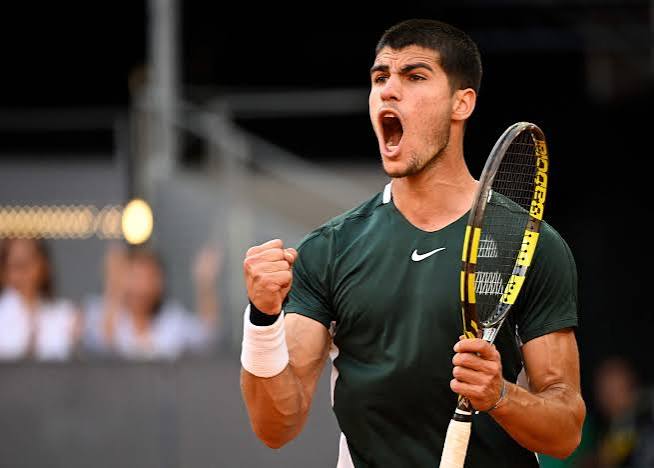
Carlos Alcaraz is only 23 years old, and somehow we are already having a conversation that would have sounded ridiculous a few years ago.
Is he ahead of Roger Federer and Rafael Nadal at the same age?
Not ahead of them in career achievements.
Not ahead of them in legacy.
Not ahead of them in total Grand Slam championships.
But at 23?
That debate is suddenly very real.
And it isn’t just fans on social media making the argument.
Tennis legend John McEnroe has now entered the conversation, saying Alcaraz is the best player he has ever seen at that age and describing him as the most complete 23-year-old player he has watched.
That’s an enormous statement when you remember who came before him.
Federer.
Nadal.
Djokovic.
These aren’t simply great tennis players. They are three of the greatest athletes the sport has ever produced.
So, has Alcaraz really done enough at 23 to say he was better than Federer and Nadal were at the same stage?
The numbers make this uncomfortable for the legends.
Seven Grand Slams at 23 Is the First Problem for Everyone Else
Let’s start with the statistic that makes this debate impossible to ignore.
Carlos Alcaraz already has seven Grand Slam singles titles.
Seven.
At 23.
That puts him ahead of where Federer and Nadal were at the same age.
Nadal had six Grand Slam titles at 23.
Federer had five.
Alcaraz has seven.
And this isn’t just about collecting trophies early.
Alcaraz has already won all four Grand Slam tournaments.
He won the Australian Open in 2026 to complete his Career Grand Slam at just 22 years and 272 days, becoming the youngest man in the Open Era to accomplish the feat.
That achievement alone puts him in extraordinarily rare territory.
Federer eventually completed the Career Grand Slam.
Nadal eventually completed it.
Djokovic eventually completed it.
Alcaraz did it before turning 23.
That’s ridiculous.
Federer Wasn’t Yet the Federer We Remember
Here’s something that gets lost whenever people compare Alcaraz to Federer.
The Federer we remember is the Federer who dominated tennis for years.
The elegant serve.
The impossible forehand.
The one-handed backhand.
The Wimbledon dominance.
The 20 Grand Slam titles.
But Federer at 23 wasn’t yet that version.
He was already a superstar.
He had five Grand Slam titles and had established himself as one of the best players in the world.
But his greatest period was still developing.
That’s important.
Because Alcaraz has already reached the stage of his career where Federer was beginning to build the foundation of his eventual dynasty.
And Alcaraz is already carrying a seven-major résumé.
ATP statistics also show just how quickly Alcaraz reached four Grand Slam titles.
He needed only 69 Grand Slam matches to win his first four majors.
Federer needed 79.
Nadal needed 81.
Alcaraz also had the highest Grand Slam winning percentage of the three at that point: 85.5%, compared with 84% for Nadal and 77.2% for Federer.
That’s not a small difference.
It shows just how quickly Alcaraz has adapted to the biggest stage.
And Then There’s Nadal — The Hardest Comparison
If we’re being honest, Nadal might be the toughest player for Alcaraz to compare himself with at 23.
Why?
Because Nadal was already a monster.
By that age, Nadal had already won six Grand Slam titles and had established himself as one of the greatest clay-court players in history.
He had also already beaten Federer in some of the biggest matches of the era.
Nadal wasn’t simply promising.
He was already dominating.
And yet Alcaraz still has a statistic that Nadal cannot match at the same age.
Seven majors versus six.
But there is another difference.
Alcaraz has already won Grand Slam titles on every surface.
That’s something Nadal had not accomplished at 23.
Nadal was historically dominant on clay, but his career eventually became much more complete.
Alcaraz has reached that level of surface versatility much earlier.
His seven majors include two US Open titles, two Wimbledon titles, two French Open titles and his first Australian Open championship.
That is an extraordinary spread.
Hard court?
Yes.
Grass?
Yes.
Clay?
Yes.
Australian Open?
Yes.
French Open?
Yes.
Wimbledon?
Yes.
US Open?
Yes.
There are almost no weaknesses in the Grand Slam résumé.
The Crazy Part Is How Complete His Game Already Is
This might actually be McEnroe’s strongest argument.
Alcaraz isn’t winning because he has one unstoppable weapon.
He isn’t simply a serve machine.
He isn’t simply a baseline grinder.
He isn’t simply a clay-court specialist.
He can attack.
He can defend.
He can come forward.
He can create impossible shots.
He can change pace.
He can play physically.
And when necessary, he can turn a match into a mental battle.
That versatility is one reason McEnroe called him the most complete player he has seen at that age.
And there is evidence beyond the eye test.
Alcaraz’s career record is already 280-65, including a 52-24 record against Top 10 opponents and a remarkable 14-1 record in deciding fifth sets, according to the ATP’s 2026 media guide.
That fifth-set record is particularly interesting.
Because when the match gets ugly, Alcaraz doesn’t seem to disappear.
He often gets better.
But Hold On — There Is One Huge Problem With This Argument
Let’s pump the brakes.
Because saying Alcaraz is better than Federer and Nadal at 23 is very different from saying Alcaraz will have a better career.
That’s where this conversation can get carried away.
Federer finished with 20 Grand Slam titles.
Nadal finished with 22.
Djokovic finished with 24.
Alcaraz has seven.
Seven is incredible.
But seven isn’t 20.
He still needs another 13 just to match Federer.
He needs 15 more to match Nadal.
And 17 more to match Djokovic.
That’s a mountain.
Injuries can happen.
Motivation can disappear.
New rivals can emerge.
And tennis is brutally demanding.
Alcaraz himself has already experienced what a long layoff can do. He missed several months in 2026 because of a wrist injury before returning for the US Open.
So we should not crown him the greatest player ever just yet.
The Sinner Factor Could Change Everything
There is another reason we should be careful.
Alcaraz isn’t dominating tennis uncontested.
Jannik Sinner exists.
And the rivalry between these two could ultimately define Alcaraz’s career.
Sinner has already won multiple Grand Slam titles and claimed the 2026 Wimbledon championship. Meanwhile, Alexander Zverev won Roland Garros in 2026.
Alcaraz currently sits behind Sinner and Zverev in the rankings after a season interrupted by injury.
That means the road ahead isn’t going to be easy.
If Alcaraz wants to chase Federer, Nadal and Djokovic’s career records, he will have to do it while battling an elite generation of players.
And that’s exactly what makes the next decade so fascinating.
The 3:33 a.m. Match Was a Warning
There is another recent storyline that shouldn’t be ignored.
At the 2026 US Open, Alcaraz’s quarter-final against Ben Shelton ended at 3:33 a.m., the latest finish in tournament history. Alcaraz has since called for Grand Slam organizers to stop matches from finishing so late.
Why does that matter?
Because Alcaraz isn’t just fighting opponents anymore.
He’s fighting the tennis calendar.
The travel.
The physical demands.
The five-set matches.
The constant pressure.
The expectation that every tournament should become another chapter in his legacy.
That’s something the next several years will test.
So Is Alcaraz Actually Better Than Federer and Nadal Were at 23?
Here’s where SportsLoud lands.
Yes — statistically, there is a legitimate argument that he is.
Seven Grand Slam titles at 23.
A Career Grand Slam completed before 23.
Grand Slam titles across all four major tournaments.
An 85%-plus Grand Slam winning rate when he reached his fourth major.
A 14-1 record in fifth sets.
And a game that appears to have almost no obvious weakness.
Those aren’t normal numbers.
They’re historical numbers.
And McEnroe’s recent assessment isn’t coming out of nowhere.
But there is a crucial distinction:
Alcaraz may be ahead of Federer and Nadal at 23 without necessarily ending up ahead of them at the end of his career.
That’s the part nobody knows.
The Real Question Is What Happens From 24 Onward
This is where the Alcaraz story gets really interesting.
He’s already done things Federer and Nadal hadn’t done at the same age.
But now comes the difficult part.
Can he maintain it?
Can he stay healthy?
Can he handle Sinner?
Can he continue winning Grand Slams after opponents figure out his game?
Can he win 10?
15?
20?
Can he stay hungry after already completing the Career Grand Slam at 22?
Those questions are impossible to answer right now.
But we can say one thing with confidence.
Alcaraz has given himself an incredible head start.
SportsLoud’s Verdict
If you ask me:
Who had the better career?
Federer and Nadal — for now.
That’s not even a debate.
Their careers are finished, and their trophy cabinets are enormous.
But if you ask:
Who was better at 23?
Now I’m taking Carlos Alcaraz.
And that’s not disrespectful to Federer or Nadal.
It’s actually a compliment to how ridiculous Alcaraz’s start has been.
At 23, he already has seven Grand Slam titles, a Career Grand Slam and major wins on every surface.
Federer had five.
Nadal had six.
And Alcaraz is still nowhere near his athletic prime.
That’s the scary part.
We aren’t looking at a player who has reached the end of his greatness.
We’re potentially watching the beginning of it.
The tennis world spent years wondering who could possibly follow Federer, Nadal and Djokovic.
Now we may finally have the answer.
Carlos Alcaraz isn’t the next Federer or the next Nadal.
He may be the first Carlos Alcaraz.
And if he stays healthy, keeps improving and survives the Sinner rivalry, we could eventually be asking a much bigger question:
Did we just watch the beginning of another all-time great career?